Guardrails for AI in Software Architecture: Why ADRs matter?
Oct 24, 2025
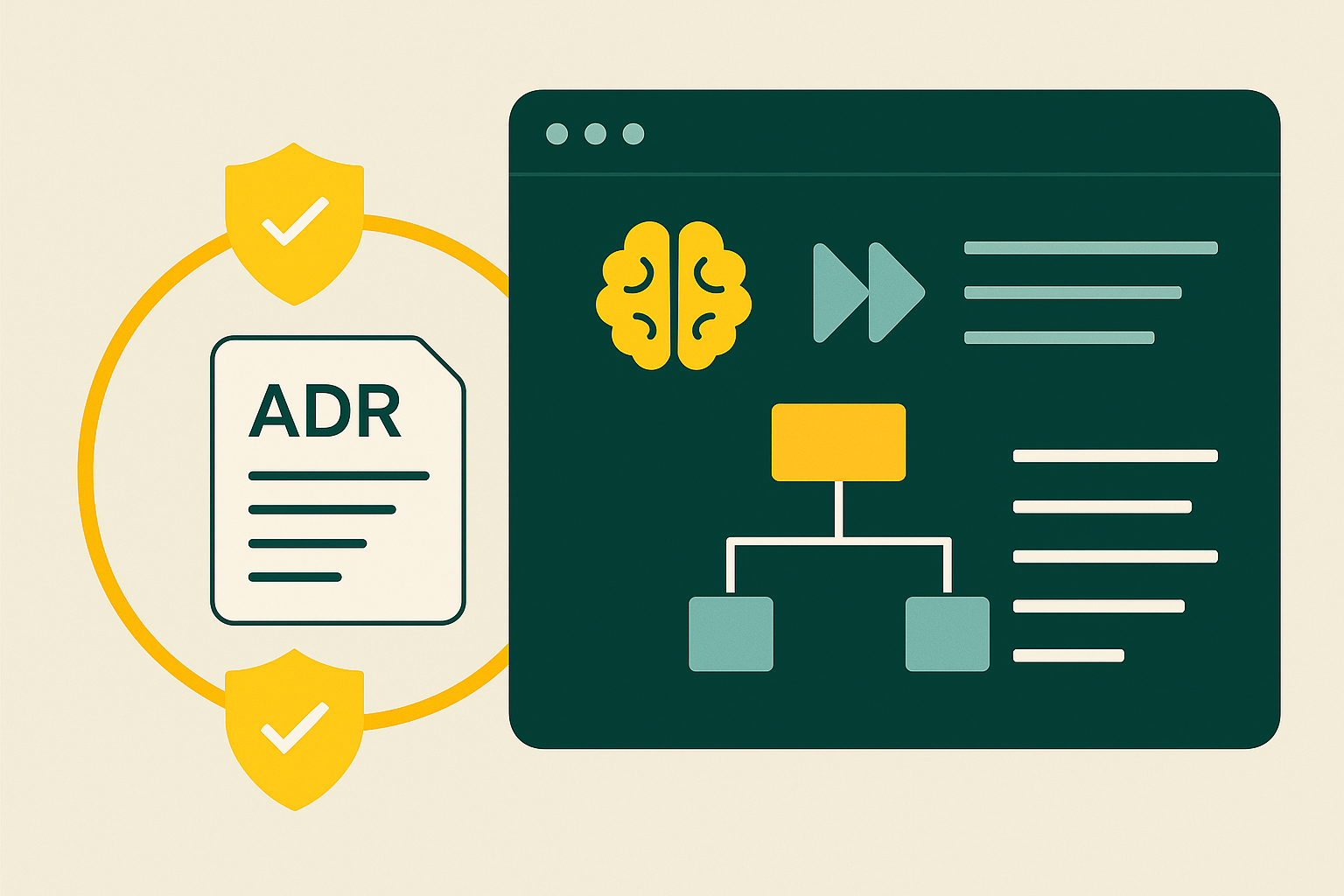
Artificial intelligence is transforming rapidly how we build and design software. Architects and developers now have access to AI copilots that can generate code, propose system topologies, and even suggest architectural patterns in seconds.
But this new speed comes with a few risks: decisions are being made faster than they are being understood, and often the decision is based on the limited context of the AI conversation.
Without context and governance, AI-driven development can quickly drift into a web of inconsistent architectures, duplicated effort and code, and invisible trade-offs.
To harness AI safely and effectively, we need guardrails — a way to ensure architectural integrity while embracing automation. One of the most powerful guardrails already exists, but many teams overlook it: Architectural Decision Records (ADRs).
The new challenge: architecture at AI speed
Modern AI tools don’t just write code — they make architectural choices, and often not the good ones. They recommend frameworks, libraries, cloud services, and data patterns. Each of these choices carries long-term implications: performance, cost, security, maintainability, and interoperability.
When humans make these decisions collaboratively, they leave behind traces — meeting notes, pull requests, design documents. When AI makes them, those traces vanish. The why behind a system’s design can disappear overnight.
Without explicit reasoning captured, future developers (or future AIs) risk undoing important trade-offs because they simply don’t know the context in which a decision was made.
That’s where ADRs come in.
ADRs: A lightweight but powerful form of governance
Architectural Decision Records are short documents that describe a single, significant technical decision and the context around it.
A typical ADR includes:
- Context: what problem or constraint led to this decision
- Decision: what was chosen and why
- Consequences: what trade-offs or side effects this introduces
They are deliberately concise — often just a few paragraphs — but collectively they form the living memory of a system’s evolution.
When used consistently, ADRs:
- Make architecture auditable and explainable
- Prevent repeated mistakes and rediscovery
- Support onboarding by showing how the system got here
- Create alignment between architects, developers, and now — AI systems
Why ADRs are the perfect guardrails for AI
AI systems are excellent at generating possibilities but poor at understanding intent. They optimize for patterns, not principles. Without clear boundaries, they might recommend an elegant but non-compliant architecture, or optimize for cost at the expense of resilience.
ADRs solve this by giving AI the missing context — the human rationale behind the current architecture.
When integrated into the development environment or architectural modeling tools, ADRs can:
- Constrain AI suggestions to align with prior decisions.
- Enable explainability, so AI can justify recommendations.
- Detect conflicts with existing architectural goals.
- Propose updates when an ADR’s assumptions become outdated.
Imagine an AI suggesting a move from REST APIs to GraphQL.
If an ADR exists explaining that REST was chosen for interoperability with legacy partners, the AI can flag this as a potential conflict and propose a gradual migration plan instead of a complete rewrite.
That’s a guardrail in action — not a restriction, but a context-aware boundary for safe innovation.
From documentation to living knowledge
The most common reason teams abandon ADRs is that they become stale.
They’re often stored in a markdown folder, forgotten after initial setup.
In a world where architecture evolves continuously — especially under AI-driven development — static ADRs aren’t enough. They need to become living, connected, and discoverable.
That means:
- Linking ADRs directly to diagrams and components
- Tracking dependencies and impacts between ADRs and code
- Automating updates when a system change contradicts an ADR
- Surfacing ADR context inside AI tools, CI/CD pipelines, and design reviews
When ADRs become part of the architecture model itself, they shift from passive documentation to active governance assets.
They evolve with the system — and with the AI that supports it.
Hivebuilder’s approach: context as a first-class citizen
Hivebuilder was designed around a simple principle:
AI in architecture should be guided, not unleashed.
In Hivebuilder, every diagram, node, and relationship can be associated with ADRs. The platform’s AI doesn’t just see shapes and arrows — it understands decisions, trade-offs, and quality goals behind them.
When AI proposes a change, it checks existing ADRs before acting.
When a new pattern emerges, it can draft ADRs automatically, summarizing rationale and alternatives.
When architecture evolves, Hivebuilder highlights outdated or conflicting ADRs, prompting review instead of silent drift.
This integration creates a feedback loop between human intent and AI assistance — a foundation for responsible, explainable architecture.
Responsible AI starts with architectural memory
The future of software architecture is not human versus AI; it’s human with AI.
But collaboration requires shared understanding — and understanding requires memory. ADRs provide that memory. They ensure that architectural decisions are:
- Traceable over time
- Aligned with organizational principles
- Understandable to both humans and machines
In an era where AI can build faster than teams can think, ADRs are how we keep our systems intentional. AI may accelerate architecture, but ADRs keep it grounded.
Conclusion
AI gives us incredible creative power in software design — but without guardrails, it risks amplifying chaos instead of clarity. Architectural Decision Records are not just documentation; they’re the connective tissue of responsible AI-assisted architecture.
By embedding ADRs into the design process and making them visible to AI systems, we transform architecture from a collection of diagrams into a living ecosystem of decisions, principles, and context.
That’s the philosophy at the heart of HiveBuilder:
Empowering teams to innovate safely, design intelligently, and keep the “why” behind every system alive — no matter how fast AI helps us build.
🔗 Want to learn more about integrating ADRs and AI in your architecture practice?
Visit Hivebuilder Insights for guides, examples, and architectural governance patterns for the AI era.